

On January 26, 2026, a once-in-165-years cosmic event is quietly unfolding. Neptune — this giant planet 4.5 billion kilometers away from us, taking 165 years to complete one orbit around the Sun — is finally stepping from its last station in Pisces into the starting line of Aries.
This is no ordinary astrological shift. The last time Neptune crossed this cosmic coordinate was in 1862 — when Lincoln had just signed the Emancipation Proclamation, the American Civil War had just ignited, and the world had no electric lights, cars, or internet. In the 165 years since, humanity has witnessed two World Wars, landed on the Moon, and invented the internet, while Neptune has only just completed one full orbit around the Sun, returning to its starting point.
Now, it stands once again at Aries' threshold, launching a new 14-year cycle (2026-2038) for our generation. These 14 years will determine how humanity confronts the AI revolution, climate crisis, and social restructuring — will we continue dreaming in virtual worlds, or will we take up arms to fight for our ideals?
And when the universe's fundamental frequency switches from "water" (Pisces) to "fire" (Aries), every person's spiritual world will experience a storm: anxiety, insomnia, loss of direction, internal conflict... Like when your WiFi signal switches from 2.4G to 5G, your "receiver" needs retuning.
Let's begin with the solar system's "highway" and gradually unveil the scientific truth behind this 165-year mystery.
## The Solar System's "Circular Track": Why Do Stars "Move Into" Different Constellations?
Imagine standing at the center of a vast field — this is the Sun. Around you is a 400-meter circular track, and all the planets — Mercury, Venus, Earth, Mars, Jupiter, Saturn, all the way to distant Neptune — are running laps around you on this track. This "track," in astronomical terms, is called the **"ecliptic."**
Ancient peoples, observing the sky, divided this track into 12 segments, each corresponding to a background constellation, like road signs posted every 33 meters: the first segment is Aries (starting point), the second is Taurus, the third is Gemini... all the way to the twelfth segment Pisces, then back to Aries' starting point. These constellations themselves don't move; they're like trees and buildings by the roadside — just "background scenery."
But planets do move. When a planet slowly shifts along the track, viewed from Earth, it appears to move from the "Aries background" to the "Taurus background," then to the "Gemini background" — this is the true meaning of "a planet entering a constellation."
So, **"Neptune entering Aries"** actually means: this slowest super-truck in the universe has finally driven from the "Pisces gas station" to the "Aries gas station."
## Why Does Neptune Move So Slowly? Evidence from Physical Laws
This isn't mysticism, but the inevitable result of physical laws discovered by Kepler 400 years ago. Kepler's Third Law tells us: the farther a planet is from the Sun, the slower it moves.
Neptune is 4.5 billion kilometers from the Sun — 30 times Earth's distance. Its speed is mind-numbingly slow — it takes 165 years to orbit the Sun once, and 14 years to pass through one constellation. By comparison, Earth takes only 1 month to pass through a constellation, Jupiter takes 1 year, and Saturn takes 2.5 years.
This means **a human lifetime (80 years) can only witness Neptune traversing 5-6 constellations**. For Neptune to return to its starting point (Aries 0°) requires a full 165 years — exceeding two generations' lifespans.
So when it returns to the starting point, this is not merely an astronomical event, but a **time marker spanning three centuries**: last time was 1862's Civil War era, this time is 2026's AI age, and next time will be 2191 — your great-great-great-grandchildren's era.
## From "Dream Ocean" to "Battle Flames": The Great Energy Switch
From 2011 to 2026, for these 14 years, Neptune has been stationed in Pisces — the last of the twelve signs, symbolizing dissolution, dreams, and blurred boundaries. During this cycle, social media exploded (virtual socializing replacing real contact), short videos became addictive (fragmented dreams), and metaverse concepts emerged (digital illusions). Neptune in Pisces is like a vast ocean, immersing people in endless information streams, creating the illusion of "connecting to the whole world," but also causing people to lose direction, become addicted to the virtual, and escape reality.
But starting in 2026, Neptune enters Aries — the first of the twelve signs, symbolizing ignition, pioneering, and battle. Aries is a fire sign; it no longer asks "who am I," but shouts "what do I want." It's not satisfied with dreaming but takes up weapons to realize dreams.
History has already demonstrated this transformation for us. From 1862 to 1875, during Neptune's last 14 years in Aries, what happened in the world?
**In 1863**, Lincoln signed the Emancipation Proclamation, and the American Civil War erupted — this wasn't a war for land or wealth, but a battle for the ideal of "all people are equal." This is the classic manifestation of Neptune (ideals) in Aries (battle).
**In 1869**, the First Transcontinental Railroad in America was completed. This railway connected the East and West coasts. Workers spent 6 years crossing deserts, scaling mountains, and carving out a steel path through completely unknown wilderness — this is Aries' "pioneering spirit."
**In 1870**, the women's suffrage movement arose in America and Britain. Women were no longer satisfied with the traditional role of being "gentle and virtuous" and began fighting for voting rights, education rights, and work rights — this is individual awakening (Aries) breaking through collective conditioning.
**In 1874**, the first Impressionist exhibition was held in Paris, France. Painters like Monet and Renoir broke classical painting rules, no longer painting "what should be" but painting "real feelings" — this is art (Neptune) meeting revolution (Aries) in sparks.
Behind every event is the same theme: **People were no longer satisfied with accepting the status quo, but actively fought for ideals and beliefs.**
## 2026-2038: What Challenges Are We Facing?
If we piece together the historical events from Neptune's last Aries period (1862-1875) into a painting, you'd see: the abolition of slavery, railway construction, women's awakening, artistic revolution — each a story of "fighting for ideals."
So this time (2026-2038), what crossroads do we stand at?
**The Rise of AI** — ChatGPT burst onto the scene in 2023, various AI tools exploded in 2024, and by 2026, AI has penetrated every aspect of work, creation, and socializing. Is it a tool, or will it become the master? We need to redefine the meaning of "human." This question is no longer philosophical speculation but requires immediate choices: Do we treat AI as a partner extending human capabilities, or let it replace human thinking?
**Climate Tipping Point** — Extreme heat, melting glaciers, rising sea levels, species extinction... Scientists warn we have less than 10 years left to reverse climate collapse. This isn't a "next generation" problem but a battle "this generation" must face. Neptune's 14 years in Aries (2026-2038) coincidentally overlaps with this critical window.
**Social Restructuring** — Wealth inequality reaches historic highs, young people lose hope of upward mobility, conflicts between traditional values and new generations intensify... The old order is crumbling, new rules aren't yet established. Everyone is asking: Is there still a place for me in this world? What should I live for?
Neptune's 14 years in Aries will determine whether we choose "dreams" or "action," "escape" or "pioneering" on these questions.
## When Energy Shifts, Your Body Will Speak
When the universe's fundamental frequency switches from "water" to "fire," humanity's collective energy field undergoes violent shock. Like when your phone switches from WiFi to 5G, without a proper "signal adapter," you'll feel:
**Energy Chaos** — Sometimes too wired to sleep, sometimes too exhausted to get up; emotions like a rollercoaster, fighting spirit one second, despair the next. This isn't your problem — it's the external energy field suddenly changing while your internal system is still adjusting.
**Lost Direction** — An intense "I need to do something" impulse, but not knowing what; wanting change but not knowing where to go; having energy but not knowing where to direct it. This is fire energy (Aries) driving action but lacking water's wisdom (Neptune) to guide direction.
**Internal Tearing** — Wanting to give up yet feeling guilty; wanting courage yet feeling fear; wanting to pursue ideals yet feeling impractical. This is the old "watery" survival mode (going with the flow, blurred boundaries) clashing with the new "fiery" era's demands (clear self, proactive initiative).
These symptoms already began appearing in late 2025, will peak in 2026, and persist through 2026-2027. This isn't disease but a normal reaction during the energy transition period — like a snake shedding skin or a butterfly breaking from its cocoon, the process is painful but the result is rebirth.
The question is: Is there anything that can help us navigate this transition more smoothly?
## Nature's Answer: A Deep Blue Stone
Thousands of years before humans invented telescopes and knew Neptune existed, a deep blue stone had already been regarded by Egyptian pharaohs, Sumerian priests, and ancient Greek philosophers as a symbol of "truth and courage."
It's called **Lapis Lazuli**.
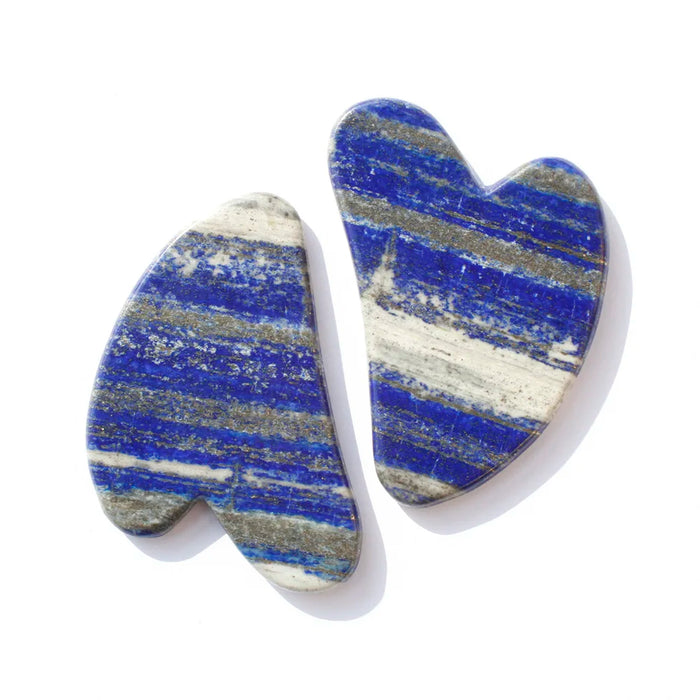
When modern mineralogists examined this stone with microscopes and spectrometers, they discovered an astonishing coincidence: **Lapis Lazuli's chemical composition perfectly corresponds to the physical picture of "Neptune (deep blue) entering Aries (iron/gold)."**
## From Chemical Elements to Cosmic Energy: Lapis Lazuli's Scientific Code
Lapis Lazuli isn't a single mineral but a composite rock. When you pick up a piece of lapis lazuli, you'll see:
**Deep Blue Matrix** — This is the lazurite mineral, with a chemical formula containing sulfur and sodium: Na₈(Al₆Si₆O₂₄)S₂. This deep blue color perfectly matches Neptune's visual color (ice blue/deep blue) on the spectrum. It represents the unconscious, dreams, intuition, and the vastness of the spiritual world. Holding it is like holding Neptune's "backdrop."
**Golden Specks** — These aren't real gold but pyrite, with the chemical formula FeS₂. Note this key element: **Fe = Iron**.
Here lies an astonishing chemical coincidence:
In astrology, Aries' ruling planet is **Mars**.
Mars in ancient alchemy corresponds to the metal **iron**.
Mars' surface appears red because it's rich in **iron oxide** (rust).
So the golden specks in lapis lazuli chemically introduce **Aries/Mars energy** directly!
**A high-quality lapis lazuli = a deep blue ocean (Neptune) sparkling with golden fire (Aries' iron).**
This isn't human design but nature's masterpiece, prepared billions of years ago in mineral form as an "energy anchor" for humanity in 2026.
## How Does Lapis Lazuli Help You Weather This Storm?
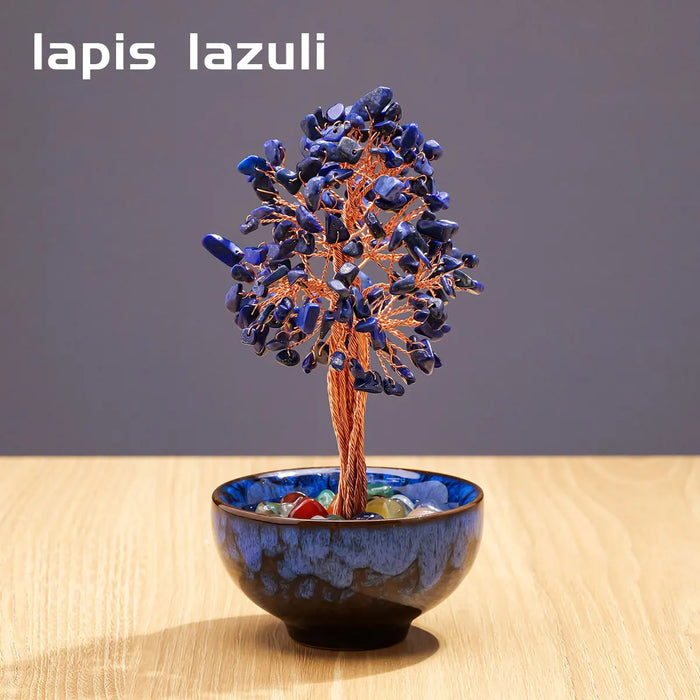
Natural minerals, having undergone billions of years of geological pressure, store Earth's most stable energy frequencies. When you place a lapis lazuli sculpture in your home, display a lapis lazuli sphere on your office desk, or keep a lapis lazuli raw stone in your bedroom, it serves three functions:
**First Function: Energy Buffer Zone**
Lapis lazuli's deep blue frequency sits between Pisces' indigo and Aries' red, acting as an energy transition zone, helping your frequency smoothly switch from "water" to "fire," avoiding violent tears in your energy system. Like jumping from ice water into hot water causes shock, but with warm water in between, you can adapt smoothly.
**Second Function: Nervous System Calming**
Scientific research shows blue light waves have a calming effect on the human parasympathetic nervous system, reducing stress hormone (cortisol) levels and improving sleep quality. When you see or touch this deep blue stone daily, your nervous system receives a "safe" signal. During the energy transition period's restlessness, it's like a gentle hand pressing on your trembling heart.
**Third Function: Action Power Activation**
The iron element in lapis lazuli (pyrite) interacts with your blood system at the energy resonance level, activating your "Mars energy" — the **ability to transform ideas into action**. You'll find yourself no longer just "thinking" but starting to "do"; no longer just "dreaming" but starting to "plan"; no longer just "fearing" but starting to "be brave."
## Why This Particular Stone?
Among thousands of minerals and gemstones on the market, why lapis lazuli specifically?
Because it's the **only naturally occurring mineral that simultaneously contains "Neptune elements" (sulfur, sodium, deep blue) and "Aries elements" (iron, gold) in mineralogy**.
More miraculous is that this combination isn't synthetic but nature's masterpiece. When sulfides crystallize into blue lazurite under high temperature and pressure, when iron elements deposit as golden pyrite in cracks, when calcite forms white veining in spaces — these three minerals coexist in perfect proportions, forming a gemstone that's both profound and edged.
Egyptian pharaohs made amulets from lapis lazuli, believing it connected heaven and earth. Sumerian civilization called it the "stone of the sky," using it in divination rituals. Greek philosopher Plato believed lapis lazuli could manifest the "world of Ideas" — that archetypal ideal world. Medieval painters ground lapis lazuli into pigment to paint the Virgin Mary's cloak, believing this blue came from heaven.
For thousands of years, countless civilizations have believed lapis lazuli symbolizes "truth and courage." Now, when we re-examine it with modern mineralogy and astrophysics, we find those ancient intuitions had astonishing scientific foundations.
## Your Neptune Moment
On January 26, 2026, when Neptune officially crosses Aries' starting line, it will remain there for 14 years until 2038.
These 14 years are the **only complete Neptune zodiac cycle our generation can fully experience** (because the next 14-year cycle from 2038-2052, most readers will be middle-aged or elderly).
Miss this window, and the next time Neptune returns to Aries will be 2191 — by then, you and I will be long gone, but the choices we make now will leave marks in history.
When descendants 165 years hence open history books, they'll see this passage:
> "In 2026, when Neptune returned to Aries, humanity first truly realized they were not just Earth citizens but cosmic citizens. That generation chose a deep blue stone sparkling with golden fire as their symbol of courage. They explained its chemical composition with science, understood its energy frequency with wisdom, and proved its power with action. They were the generation that moved from dreams to pioneering, the vanguard of the Neptune era."
And you will be a witness to that history.
When you place a lapis lazuli sculpture in your home, position a lapis lazuli raw stone on your office desk, or display a lapis lazuli sphere in your living room, you're not "owning" a decorative piece but establishing an energy connection spanning the cosmos with Neptune 4.5 billion kilometers away and Mars 55 million kilometers away.
This stone will remind you: **In this era full of fog and uncertainty, you can still see clearly and walk bravely forward.**


